
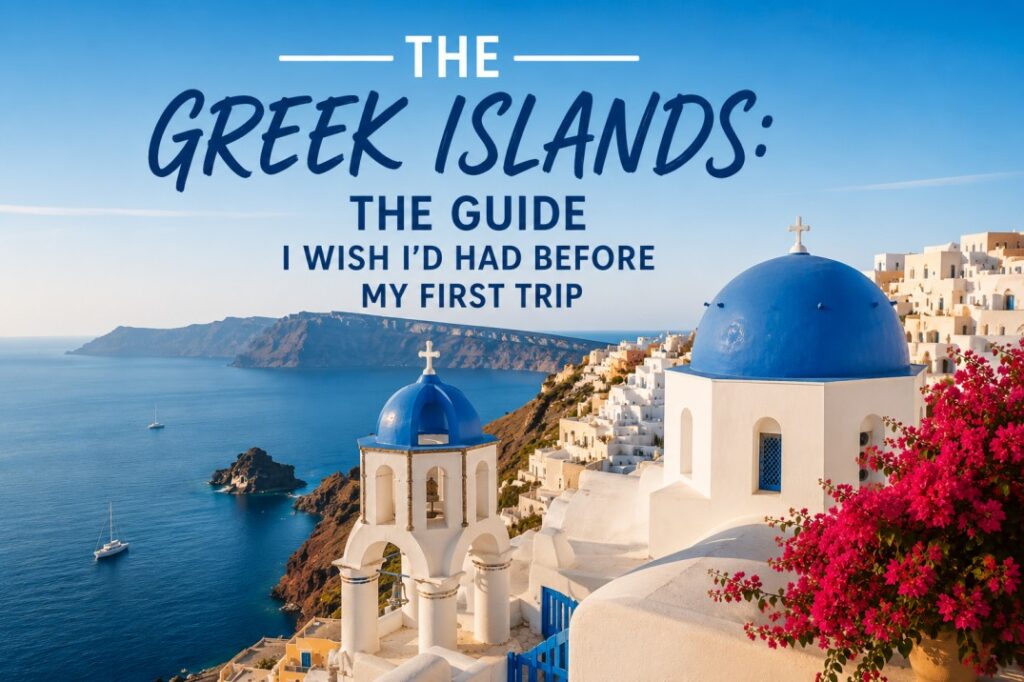

The Greek Islands: The Guide I Wish I’d Had Before My First Trip
Is it actually safe. Which island to pick. What you’ll definitely forget to pack. Let’s go through all of it, honestly, one at a time.
 ·
August 30, 2026
·
9 min read
·
August 30, 2026
·
9 min read
A friend of mine texted me in March, mid-panic: “Is it actually safe to go to Greece right now? I keep seeing stuff about a war near there and I don’t know if I should just eat the cost of my flights.” She’d booked a trip to Naxos back in January, long before any of that made headlines, and now she was seriously considering cancelling.
I understood completely, because I’d been just as jumpy before my own first trip. I remember googling “is Mykonos safe” close to midnight, scrolling through forum posts written by people who, as far as I could tell, had never been anywhere near the Aegean. So I did what I always do before something that actually matters to me: I over-researched for a week, then went anyway. It turned out to be one of the best trips I’ve taken.
This is basically the guide I built for her, and I’m handing it to you now too. If you’re standing at the edge of booking your first trip to the Greek islands, you’ve probably got a version of the same three questions circling your head: is it actually safe, which island do I even pick, and what am I definitely forgetting to pack. Let’s get into all three.
Okay, Let’s Deal With the Scary Headlines First
Here’s the honest version of what actually happened, because I think it explains the panic pretty well. In late February 2026, the US and Israel launched strikes on Iran, and things escalated fast — within days, a drone strike hit a British military base in Cyprus, which is genuinely close to Greece. If you were half-following the news and vaguely remembered that Greece and Cyprus are neighbors, typing “is Greece safe right now” into Google was a completely reasonable move. My friend wasn’t being paranoid. She was reacting to something real.
But here’s what I told her, and what’s still true as I’m writing this: Greece’s own travel advisory never moved. The U.S. State Department has kept it at Level 1, “Exercise Normal Precautions,” the lowest risk category that exists, the entire time, and never tied any elevation to the Middle East situation. The UK, Ireland, and Australia have all said essentially the same thing well into August. There’s even reporting suggesting Greece picked up extra bookings this year, from travelers who got nervous about Turkey, Cyprus, or Israel and rerouted somewhere that felt steadier.
That doesn’t mean nothing is worth watching. It just means the thing worth watching isn’t a war zone, it’s wildfires. Crete had serious fires around Rethymnon in early August that forced real evacuations, which is honestly more useful to have on your radar than geopolitics.
My actual advice: don’t take your safety read from headlines or a forum thread. Check the official government advisory for your own country a few days before you fly (they’re updated constantly, and far more boring and accurate than anything on social media), get decent travel insurance, and then let yourself stop worrying and start planning the parts that are actually fun.
So… Which Island Do You Actually Pick?
This is the part that stresses people out more than safety, honestly, because there isn’t one “Greek islands.” There are roughly 200 inhabited ones, and picking blind feels like throwing a dart at a map. Here’s how I’d actually break it down for someone going for the first time.
Naxos
Best for: first-timers & easy budgets · Skip if: you’re craving nonstop nightlife
This is the easiest possible first trip. It’s the largest of the Cyclades, it has real beaches instead of the tiny crowded strip you see in every Santorini photo, an actual working town rather than a stage set for tourists, and it costs less than its famous neighbors. I’ve pointed more first-timers toward Naxos than anywhere else, and nobody has ever come back disappointed.
Santorini
Best for: the postcard shot & short stays · Skip if: you’re on a tight budget or you hate crowds
This is the postcard: whitewashed houses stacked above the caldera, the sunset everyone photographs. Go for two or three nights, not seven. It earns its reputation, and I’d never tell anyone to skip it, but the crowds and prices in peak season are real, and most of what makes it special you can absorb in a couple of days.
Milos
Best for: still feeling like a slight secret · Skip if: you need lots of nightlife or infrastructure
The volcanic coastline at Sarakiniko looks like the surface of the moon, the fishing village of Klima is one of the prettiest places I’ve stood in Greece, and it still doesn’t see anywhere near the crowds of the islands everyone already knows.
Folegandros or Amorgos
Best for: actual, can’t-hear-anything-but-the-sea quiet · Skip if: it’s your very first trip ever (harder to reach)
Smaller, harder to reach, and exactly why people who’ve already been to Greece a few times keep going back to them instead of the famous names.
One thing I’d genuinely push back on: don’t try to see five islands on a first trip. Pick two, maybe three, and give yourself real time in each. Island-hopping sounds efficient on paper and turns into a week of hauling luggage on and off ferries in the heat.
Ten Mistakes Worth Skipping (Because I Made Most of Them)
Let me save you some trouble.
- 01
Trying to fit too many islands into one trip — I did this on my second visit and spent more time on ferries than beaches. Two or three islands, at least two nights each, is a far better rhythm.
- 02
Not booking ferries in advance — in July and August the popular routes sell out, and a last-minute ticket can mean an extra day you didn’t plan for.
- 03
Not building slack into your ferry schedule — the Aegean gets meltemi winds in summer, and ferries genuinely get cancelled or delayed because of them. Never book a flight home for the same day as your last ferry.
- 04
Wearing sandals with zero grip — Cycladic towns are all whitewashed stone and steps, and they get slippery. Bring at least one pair of real walking shoes.
- 05
Showing up to a monastery in shorts and a tank top — most religious sites expect shoulders and knees covered. Some lend wraps at the door, but it’s smoother to just carry a light scarf.
- 06
Assuming your card works everywhere — plenty of small tavernas and family shops, especially on smaller islands, are cash-only or add a card fee. Carry some cash in small notes.
- 07
Booking a cliffside room without checking the walk — some of the most beautiful hotels in Oia, or the main town on other islands, involve dozens of steps with no elevator. Wonderful for the view, brutal with a heavy suitcase.
- 08
Only chasing the islands everyone’s already seen online — Santorini and Mykonos are famous for real reasons, but if crowds and high prices aren’t your thing, some of my best days in Greece happened on islands nobody had mentioned to me until someone finally did.
- 09
Skipping travel insurance because “nothing ever happens” — ferry cancellations, missed connections, and the occasional scooter scrape are common enough that it’s worth the cost.
- 10
Not leaving buffer time before your flight home — between wind delays, island time, and how hard it is to actually leave, give yourself at least one full day of slack before you need to be at the airport.
What to Actually Pack (and What to Leave at Home)
Pack for the towns and the churches, not just the beach.
Jeans are completely fine, nobody’s stopping you at customs for wearing them, but they get uncomfortable in peak summer heat, so I’d bring one pair for cooler evenings and lean on lighter fabrics for daytime. What matters more than jeans is footwear: bring something with real grip for cobblestones, plus proper sandals for the beach.
For monasteries and churches, pack a light scarf or sarong you can wrap over your shoulders or knees. It weighs nothing, and it saves you from being turned away, which happens more than people expect.
On food: if you’re flying in from outside the EU, don’t pack meat, dairy, or other animal products. EU biosecurity rules restrict bringing those in from non-EU countries, and they’ll be confiscated if found. Packaged, non-animal snacks are generally fine in reasonable amounts, but check your airline’s specifics close to your trip since the rules do tighten occasionally.
A few things people always forget: a reusable water bottle (you’ll go through a lot in the heat), a portable charger for long sightseeing days, motion sickness tablets if you’re at all prone to it and you’re sailing in windy season, and a small stash of cash. One more thing that’s new since a lot of people’s last trip to Europe: as of April 2026, most non-EU travelers get fingerprinted and photographed at their first Schengen border crossing under the EU’s new digital entry system, which replaced the old passport stamp. It only adds a few minutes, but it’s worth knowing about so it doesn’t catch you off guard at immigration.
Go Anyway
My friend went to Naxos in April. She sent me a photo on her second night, feet in the sand, a plate of grilled octopus in front of her, captioned “cannot believe I almost cancelled this.” That’s really the whole point of this guide. The headlines will always give you a reason to hesitate, and there will always be ten small logistics that feel overwhelming to sort out. None of it is a good enough reason to skip the trip.
The Greek islands are still exactly what they’ve always been: absurdly blue water, towns that look unreal in person, and a pace of life that makes you forget your inbox exists. Do a little homework, pick two islands instead of six, pack a scarf, and go.